Friday, 11 February 2011

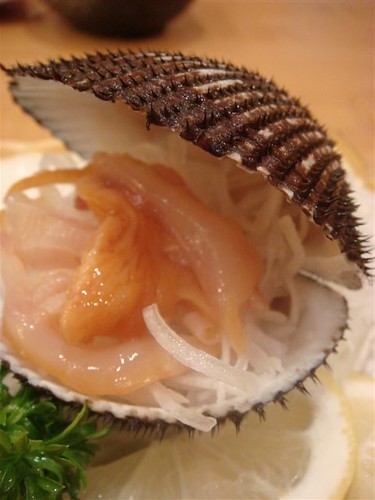
Guilty Pleasure: Akagai (red shell clam)


My grandmother was well known for being the woman who loved food and was extremely naughty - the best combination of all traits.

One day when I was about six or seven, I stayed around my grandmother's flat for the night and she decided to have a round of 'canapes' with before dinner. She boiled a large pot of water, as soon as the water started bubbling she dumped a big bowl of clams into the pot then turned the heat off and drained the clams. My grandmother then quickly picked the hot clams and pull its meat out and shoved one in my little mouth, good lord, it has woken up all the taste buds on my tongue. I don't recall tasting any other seafood as sweet as this little clam in my life again. Straight after our treat my grandmother took a couple of shot glasses from the cupboard and filled them with Chinese rice wine to 'detox' my digestive system as the clam meat was still practically raw when it landed in my grateful mouth.

'Don't tell your mother,' she looked at me as she passed me the shot glass.

I later on found out that the clams I had was called Akagai clams which was are very similar to blood clams. Akagai clams are very popular among the Eastern countries especially in Japan where they are used in sushi; the surface of the clam looks kind of dirty as it has mini spikes which traps mud in the small gaps, each clam is just about as big as the 'O' when you make an 'OK' hand gesture. The clam meat is reddish orange in colour due to its full of iron and haemoglobin. It has a crunchy and chewy texture but not at all rubbery if eaten fresh. In terms of taste its extremely sweet and the intensity is similar to oysters or sea urchin.

Back in the day my grandmother must have bought the Akagai clams from the local market in the summer, the sea must have been a lot cleaner back then so I wouldn't recommend anyone to do repeat her act again; especially not feeding a six year old rice wine! This is one of the most vivid memories I have with my crazy grandmother, thinking about this indulging experience I realised it happened no less than 16 years ago, I wonder if she remembered that day before she passed away few years ago?

...Memory fades, but the sensation lives on.

Sunday, 16 May 2010

A stroll down Tombo...


Low in cash, shitty weather and slightly homeless is not what I call an ideal start for the weekend. After a (free) trip to the V&A museum I found myself walking up and down in South Kensington with my companion aimlessly looking for something to eat.

Tombo attracted my attention with it's fresh and airy decor - and what a pleasant little find it was! The attentive waiter arrived with my terriyaki chicken bento set on my marble (*ahem*plastic) table- a piece of lightly fried tofu block with soy sauce and spring onions on top alongside with slices of slow cooked taro with a hint of sweet vinegar. Pieces of chicken (leg meat) placed on a rectangular white china plate with a bowl of sesame topped rice. Food was clean, crisp and simple - exactly how I like my food. I washed it down with a nice pot of timed germaicha before devouring a slice of ever-so-perfect green tea tart.

Why can't more places be like this one? They even have a water station where you can refill your tea pot with hot water. I loved the chilled vibe this cute little cafe sends out. The ladies who sat next to me were from some sort of modern knitting club my companion and I was reading our books...the weather suddenly seemed a little better; the sky suddenly became a little clearer and so has my mind.


Thursday, 2 July 2009

The Black Boy

I've been eating like an absolute PIG these days and I just love it. As a poor graduate (I KNOW, I CAN'T BELIEVE THAT I PASSED EITHER!), I don't usually look at restaurants which cost more than a tenner per main course, and for those restaurants that do main courses under a tenner usually disappoint me. But the Black Boy in Oxford changed my views on reasonably priced food. It was my graduation day and I picked the Black Boy to have lunch at with my army of family from Hong Kong after the ceremony ended.

Oxford city is full of pubs and I have spent enough time during my uni years to carry out my extensive research in them; students who are brave enough to eat food served by these pubs deserve medals for both their courage for swallowing without fear of projectile vomiting and their stupidity for spending money on crap. The Black Boy is a totally different story, situated in Headington in Oxford, slightly away from all the student pubs, it is a refreshing, clean and homely gastropub which serves excellent food with a reasonably pricetag.

The setting is very simple and does not lack elegance, and the menu is short but it definitely has something for everyone. I have always had a negative feel towards long menus, a short menu indicates a chef who thought carefully about what goes on the menu - quality over quanity!

I had a home-made burger (chuck steak, minced beef and brisket) topped with mature English cheddar, onion, gherkins & fries. At £8.95 it was one of the nicest burgers I have had in a while; the dish was highly presentation to a point that I knew the chef gives a damn to a burger dish. The burger was obviously homemade and I polished it off pretty swiftly. On top of all of our food the service was excellent too and we felt so welcomed there. The only thing was that the portion was leaning on the small side, but with everything else it was still amazing as I would rather pay a little more for quality than nothing for pure quantity.

Definitely worth another visit to the Black Boy - great food, great ambience with a reasonable price tag :-)

Monday, 27 October 2008

Espress(o) Yourself – A Beginner’s Guide to Coffee


What do you know about coffee?

Everyone knows what coffee is, but far fewer people are familiar with the most basic details of the core of coffee – espresso. Espresso was developed in Milan, Italy, and is a concentrated coffee beverage brewed by forcing very hot water, under high pressure, through coffee (approx. 45ml) that has been ground to a consistency between extremely fine and powder.

The origin of the term ‘espresso’ is the subject of considerable debate. Although some Anglo-American dictionaries simply refer to ‘pressed-out’, ‘espresso’, much like the English word ‘express’, conveys the sense of ‘just for you’ and ‘quickly’, both of which relate to the method of espresso preparation. Below are the basic clarifications on what’s what in the espresso world.

· Affogato – meaning ‘drowned’, is espresso served over ice cream

· Americano – espresso topped with hot water to the strength of filter coffee

· Café Crème – espresso with added steamed milk, very similar to latte

· Cappuccino – an espresso shot of coffee topped with hot milk and foam

· Con Panna – coffee topped with whipped cream

· Corretto – meaning ‘corrected’, is espresso with added alcohol, usually brandy or sambuca

· Doppio – meaning ‘double’, is two shots of espresso in one cup

· Einspanner – Lungo topped with whipped cream

· Latte – meaning ‘milk’, is a hot glass of milk with an espresso shot poured in to create a three-layered look. Surprising to many, the layer of thick foam is the only difference between a latte and a cappuccino!

· Lungo – meaning ‘long’, is an espresso made with double the amount of water, producing a weaker drink

· Macchiato – meaning ‘stained’, is an espresso shot with a teaspoon of milk and foam on top. Contrary to popular belief, macchiato is not one of those caramel-flavoured iced coffee drinks they make in Starbucks!

· Marochino – an espresso topped with hot milk and foam and covered in cocoa powder, best served in a glass, although most places serve cappuccino in exactly the same way as marochino

· Mocha – a rich hot chocolate, topped with an espresso, hot milk and foam

· Ristretto – meaning ‘shortened’, is an espresso made with less water, yielding a coffee that has more essential flavour but less caffeine content

Saturday, 30 August 2008

Food as Art


Apart from my obvious interest in food, art is my other passion, I enjoy discovering different types of art movements, reading about the meaning behind a piece of crap (and then realise maybe it is not as crappy as I first thought). But not until I was old enough to join the two together by appreciate food as art and chefs as artists, mainly being influenced by TV programmes such as Great British Menu which show the skills and dedication of some of the best chefs in the world in creating some heavenly-looking dishes..


For a long time I was determined that food is in fact art, and would argue to death with anyone who disagrees with me. Why isn't food art? Before the Mona Lisa became THE 'Mona Lisa' it was merely oil paint in their primary colours; before Coq au Vin became Coq au Vin it was only rooster and wine but both products become such pleasure to our senses after the artist or chef worked their magic. The topic of food as an art form interests me so much I decided to make it the title of my dissertation, it is when I started doing research for it I started realise it is much more complicated than I thought to define 'art'.

Some say art is a combination of skill and imagination, therefore food would definitely be qualified as art as it consists both. But then art can be differentiated into different parts, such as 'craft', 'fine art', 'pure art' and 'applied art'. Fine art and pure art have no use apart for one's aesthetic desires; however, a designer cannot design an applied-art form without having a function in mind. Applied art forms such as fashion, architecture and interior designs already have their own functions same as food has its own nutritional values, and the artistic value is only added afterwards; and fine art cannot be pure art if there is a function within the product itself. Food can only satisfy the aesthetic senses, it doesn't provide the same emotional satisfaction you would achieve by listening to a meaningful piece of music.

So food is not a form of fine art, but then what is? there are more so called 'art' exists that required much less to none skills or imagination at all., obviously art is a very subjective and opinions varies from person to person, but just because someone gives a the label of 'art' to a product does not make it more artistic than a plate of gourmet food. At times it really makes my blood boils to see some meaningless piece of so-called 'art' being sold for millions of pounds, like Mark Rothko's art, i tried so hard to get into his mind with all the literature about it, and went back to view his paintings again and again, but i still think its shite.
Then again, maybe its me who doesnt know how to appreciate such things, i guess it depends how one percieves things. I still think I am right though:p/

Friday, 8 August 2008

Slow Food Turda


I still remember when I was first introduced to Slow Food in a Gastronomy lecture, I have to say it wasnt the most memorable lectures I have ever had. Slow Food is an organisation which created the food movement against fast food. Their objectives include educating students and consumers about the risks of fast food, various political programs to preserve family farms, promoting taste education, and mainly preserving local and traditional food products.

After the lecture a member of Slow Food UK gave us a tasting session on various types of meats, cheeses and perry. One of us students raised a question of how the majority of the general public would not be able to afford the high end of the organic food markets since in UK, the key to keep food production authentic and ethical is to have a rich producer, and therefore a hefty price tag on each package.
The man from Slow Food dissapointing said that the general public should eat less but better, using the same amount of money to buy organic food even though you only get half the portion, if you are lucky. To me that was a ridiculous answer, so we should eat less and pay more in order to maintain these objectives, in that case the majority of the country would not get involved in this organisation in any way! More to the point, is it just a lifestyle preference rather than a political food movement we are discussing here?

I didnt have a great start with Slow Food; until one day ?I had the opportunity to work with Slow Food Turda. It was a programme sponsored by my university for a number of students to go to Turda, a small town in Romania, to experience what exactly Slow Food do.

I did not know what to expect, my first impression of Turda was very that the lifestyle is very simple. I was so excited to see the local marketplace on the first day. There was radishes EVERYWHERE; literally every single store there were beautiful radishes in massive bunches with bright pink colours. It was quite amusing, but you understanding straight away that they only sell seasonal produce, which is extremely different to the UK with our water-flavoured tomatoes.

We were planned to go to three villages to give presentations and food tastings to the villagers to educate them in how their products can be sold in other countries without damaging the traditions; as well as legislation and general hygiene information.

WE held our first presentation in a villager's back garden. The owner showed us around the garden and told us how she grows everything herself to support herself and her family. Coming from a very cosmopolitan background, I was so surprised how simple life is in Turda. We cut up local traditional cheeses and commercial pre-packed cheeses, as well as fruit jam for locals to taste the difference, and dressed the table with fresh vegetables and fruits and explained how in countries like UK, consumers crave for fresh produce as such. Not many villagers turned up, but our spirit was still high.

The second village we went to has more locals turned up for the presentation. After the presentation we were invited by the local host for lunch in their garden under the lovely weather. We had some Romanian goulash and home made wine, one of the ladies told me the sausages in the pot of goulash was made by the host family. It was surprising enough to hear that they make sausages out of fresh mince. But I was more surprised by the fact that the mince was from its their own pig! An old lady from the village showed us around, she showed us the hills and told us how the soldiers fought there in the world war; she showed us the meanings of each symbol on all of the cemetries; She took us to the top of the hills to see the views on Turda. Turda was no longer a strange place to us, it has meanings and history everywhere.

The last village we went to was the most special to me. There were a lot more of us on the last day, I wasnt really needed to prepare the presentation therefore I started 'babysitting' the local kids andI was so touched by how friendly they are. I dont speak Romanian and they don't speak English but we managed to communicate and had lots of fun. It was almost unreal to see the amount of animals there are in each household, I have never stood so close to a cow before. It may sound amusing but it was true!

We ate some of the best polenta I have ever tasted, some gorgeous cake and some donuts. These food were so tasty as it is, but we appreciated it even more so because we know its from the gardens of all the family farmers in front of us, and we know they worked hard and are proud of their food. A young Romanian journalist explained to us that the Romanian locals are sceptical about changes because of their political background of being a communist country. People have no faith in improvements, therefore even though they are proud of their food, they may not have the confidence or belief that they can make any changes. We tried to explain with the help of the council and stamina from the villagers, things could improve. But in the back of our heads we could all understand why the villagers would have no faith.

One of the translation ladies took us to see her brother in law, as we were in the car driving on a bumpy road, suddenly she turned and drove onto a hill and carried on driving. I was edament that she was joking, the hill was bare, I mean who lives on a hill with nothing? My jaws literally dropped when we arrived. She told me that those tiny little huts that scattered around the hills are the accomodation for each farmer for half the year in order to pet the animals. The hut was dead simple, so simple I wont even be able to stay for a night. There wasnt even a bed, only a few cloths put together and a bucket of water. On the ceilings there are rails which they put the big blocks of cheeses.
I looked around me and inhaled deeply, it was all green and there were cows and chickens running around, the villagers must have thought I was crazy for being so amazed at the hills but I was speechless at the perfect simplicity.

I am not sure how much I have contributed in this trip, or even given any help at all. But I have learnt so much not just about food, but lifestyle in general, and how simple things could put a smile on people's faces. It made me almost a bit ashamed of our attitude in life, moaning about not having this season's latest fashion or not being able to afford an iPod seem to be so pathetic. These people work for life, but not luxury and yet they are much more satisfied with life than any of us.

If anyone asked me how would the majority of people in UK afford Slow Food products, I would say not everyone can afford it because it costs a lot to maintain the local traditional foods, but if we don't start from there, one day the traditions will be lost, and even the richest person in the world wouldn't be able to buy such local food.

Sunday, 3 August 2008

Delia Smith


Delia Smith has got to be the first chefs (or COOK, as I have once been seriously told by Paul Levy on the phone during an interview, whilst being completely hungover) that I have seen on TV. I must have been about 10, still living in Hong Kong and not really understanding what the English woman was saying, although I understood she was teaching us how to boil an egg.


I was never a big fan of Delia's cooking in the first place, maybe it's her tone of voice, or the fact that she was teaching how to boil an egg, but I have always found her cooking fairly boring. Delia published the book How To Cheat At Cooking in February 2008, which created an uproar by the whole army of celebrity chefs. It is true that frozen mash and pre-crisp bacon are not real cooking, as Aldo Zilli has pointed out by trying out some of the recipes in her new book, that the mushroom risotto tastes like 'pig piss down your neck'.

What I don't understand is that food issues are so discussed these days, everyone is urged to buy organic food etc; and here comes the courageous Delia with her recipe book full of tinned food. Whatever her reasons are for publishing this book, I have to say this woman has balls.

For food enthusiasts who actually spend time to read about these food articles /blogs, they probably have never experienced a time desperate enough to buy a ready meal. But there are many people who has full time jobs and kids who just buy tinned and frozen food for dinner because they simply don't have the time to cook or even for shop for food. If they are going to eat junk food anyway, what is the harm in putting a bit of creativity in junk food? Another Jamie Oliver cookbook is not going to make certain people go back to the kitchen, but at least another Delia Smith's cheating cookbook would.
Having all these chefs going mad at Delia is almost like having Stevie Wonder commenting on the Cheeky Girls' latest progress; it is aiming at a completely different type of audience. People who'd buy Delia's cookbook would not have had the will to buy fresh ingredients to cook up a meal in the first place, hence the 'cheat' bit in the title. Anyway, I would have thought controversy is exactly what Delia would want, to gain attention when she is slowly blending into the background of the new generation of television chefs. I wonder if any chefs or food writers feel just a tiny bit backfired when everyone is talking about Delia's book.